
From the desk of Dr. Catherine Johnson
It was Labor Day weekend 2018 that I signed the lease at the Clarendon Hills office and opened Precision Medical Care. Eight years — though honestly, it feels like eight minutes ago. I have such gratitude for the privilege of caring for you.
It has been a full season: conferences, travel, big practice news, and no shortage of research to bring back to you. Highlights from May through September 2026:
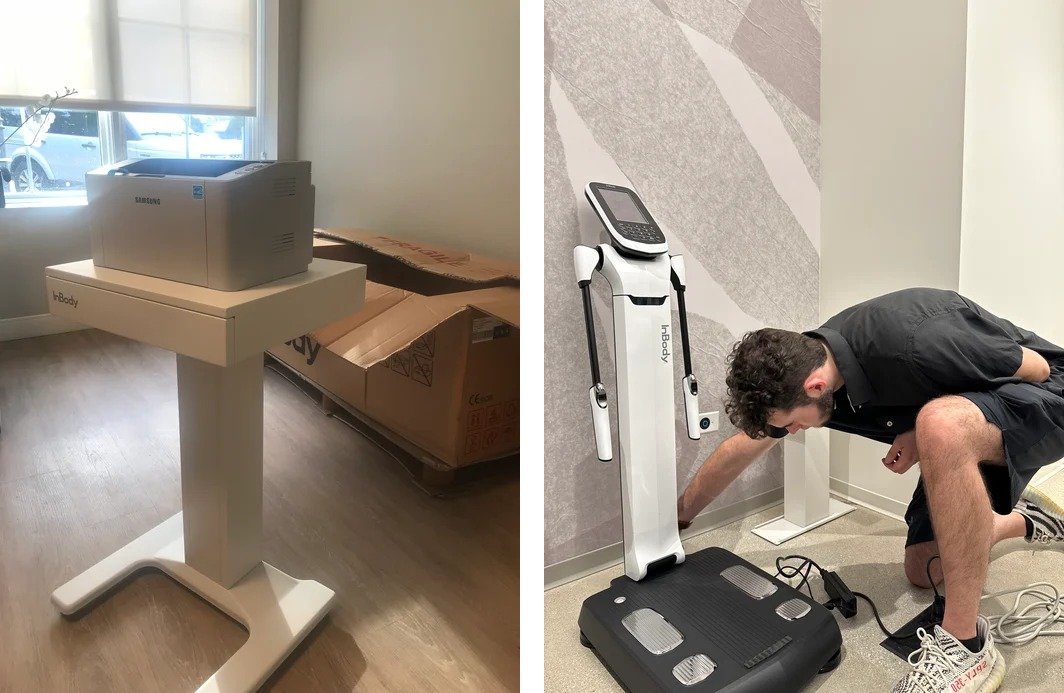
Left: Unboxing the InBody: moving day September 2018. Right: InBody installation by CJ Johnson, Fulton Market 2024.
Conference Spotlight: longevitydocs.™ Cannes 2026
My takeaway was clear: precision medicine is the clinical practice of geroscience. Dr. Nir Barzilai framed geroscience not as a field of study but as the discipline connecting interventions to outcomes — healthspan and longevity.
Precision prevention: the right treatment for the right person, at the right time. Treat earlier, to age later. Optimizing lipids, glycemia, body composition, inflammation, fitness, and sleep is no longer “just prevention” — it is targeted intervention matched to aging biology, with measurable impact on healthspan.
The data density in modern cardiometabolic care — omics, imaging, continuous glucose, wearables, remote monitoring — already exceeds human cognitive bandwidth. AI becomes the integrator that turns those streams into patient-specific decisions rather than noise. Fuse that with ambient sensing from wearables and environmental sensors, and care shifts from episodic visits to an always-on model that detects drift in biological age or cardiometabolic risk in real time. Check-ups become dynamic dashboards:
Biological age trajectories instead of single static lab values
Continuous cardiometabolic risk curves instead of isolated blood pressure or A1c snapshots
Interventions titrated to how your biology actually responds over weeks, not years
Published: PMC Patient Outcomes in Frontiers in Endocrinology
I am proud to share that our practice’s patient outcomes have been published in a peer-reviewed journal. The paper, Effects of tirzepatide therapy on body weight and body composition in adults with overweight and obesity, appeared in Frontiers in Endocrinology on July 8, 2026, with researchers at Coastal Carolina University and Texas Christian University.
This is your data — de-identified and IRB-approved, drawn from PMC records between March 2019 and December 2024. Thirty-five patients on tirzepatide, followed roughly 81 weeks, with body composition tracked on the InBody at every visit.
Mean body weight reduction: −27.8% (−31.1 kg)
Mean BMI reduction: −10.4 kg/m² (35.9 → 25.5)
Fat mass reduction: −54.2% (−26.4 kg)
Body fat percentage: 42.5% → 26.5%
Share of weight loss from fat mass: 85.7%
Patients with BMI ≥ 35 at baseline: 57% before treatment → 3% after
How this compares to the published trials. In SURMOUNT-1, patients without diabetes lost up to 22.5%, and the body composition substudy reported 21.3% over 72 weeks with roughly three-quarters of loss from fat mass. Precision Medical Care patients averaged 27.8% with 85.7% from fat mass. Those starting at BMI 35 or higher averaged 35.4%.
Preserving muscle while losing fat is the whole game — it is why we scan rather than simply weigh, and why we talk about protein and resistance training at every visit. Fat-free mass accounted for only 13.8% of total weight loss, with skeletal muscle at 8.6%.
Thank you for trusting us with your care, and for being part of work that may now help other patients and physicians.
Dr Catherine’s fall line up:
September 23 — Featured speaker at the Good Samaritan Medical Staff Fall Women’s Forum, presenting “The Precision Pivot: Identifying Early Signs of Burnout and Adapting Your Point of View for Health and Practice Longevity.” Moderated by Julie Zhu, MD, Chairperson and Anesthesiologist at Good Samaritan Hospital.
October 18 — Speaking at Chicago Menopalooza, hosted by Julie Fedeli and Pamela DeRose, authors of Midlife Upgrade
October 20–24 — The Menopause Society Annual Meeting, San Diego, serving as a judge for the scientific presentations
October 24 — Speaking at the longevitydocs.™ Skin, Bone & Muscle Mastermind in New York City — a one-day physicians-only conference on the clinical triad of healthy longevity, including how to protect skin, bone, and muscle in patients on GLP-1 therapy. Virtual attendance and replay are available
December 9–10 — Longevity Global Summit 2026 at the Buck Institute for Research on Aging in Novato, California. This year’s theme is The Future of Medicine: Eliminating Diseases of Aging, spanning drug discovery, aging clocks and biomarkers, longevity clinical trials, and regenerative medicine
December 10–13 — LongevityFest, the A4M World Congress, Las Vegas
Regulatory Watch: Peptides and Testosterone for Women
Two developments in Washington this season will shape what I can prescribe for you, and both deserve a plain explanation.
The FDA peptide committee (PCAC)
On July 23 and 24, the FDA’s Pharmacy Compounding Advisory Committee — the panel that decides which unapproved substances compounding pharmacies may legally use — reviewed seven peptides and recommended six of them for the Section 503A Bulk Drug Substances List: BPC-157, KPV, TB-500, MOTS-c, Epitalon, and Semax, each in free base and acetate form. Emideltide (DSIP) was the single rejection, narrowly, on a 6–7 vote.
What makes this notable is that FDA staff had recommended against all seven, citing minimal safety and effectiveness evidence — in some cases no human effectiveness data and no toxicology data at all. The committee voted the other way on six. Many of the committee members are physician colleagues and I admire their advocacy for expanding patients’ access to innovative therapies.
What this does and does not mean. The committee advises; it does not approve. Inclusion on the bulk list is not FDA approval of a drug, and the recommendations do not by themselves make these peptides legal to compound. That requires the FDA to act through notice-and-comment rulemaking, and the agency has not yet issued a final decision. The FDA is not bound by the committee’s vote, though it rarely diverges from it. A second committee meeting covering additional peptides is expected before the end of February 2027.
My position. I welcome a real regulatory pathway, because the status quo — a gray market with inconsistent sourcing and no quality oversight — is worse for patients than clear rules. But a favorable vote is not evidence of efficacy. The FDA’s underlying critique stands: for most of these molecules the human data are thin. I will continue to hold peptides to the same standard as everything else in this practice, which means a clear indication, a pharmacy I trust, and measurable endpoints rather than enthusiasm. I support my patients’ “right to try” peptide therapies that I can prescribe safely; the pharmacy formularies are being updated very actively.
FDA public workshop: testosterone in menopausal women
On September 17, the FDA’s Office of Women’s Health and Center for Drug Evaluation and Research convened a public workshop on Testosterone Use in Menopausal Women. To be precise about what this was: a scientific workshop examining evidence and knowledge gaps, not a hearing on a product application. No approval was granted, and none was on the table.
The core problem is one you have heard me lament at the office. No testosterone product is FDA-approved for women in the United States, while the United Kingdom, Australia, New Zealand, and South Africa have all approved or licensed female-specific formulations.
Per the workshop, the evidence supports testosterone primarily for postmenopausal women with hypoactive sexual desire disorder. Dr. Rajita Patil of UCLA noted there is insufficient evidence to recommend it for mood, cognition, or general well-being — despite what social media suggests about energy, muscle, bone, and cognition.
As many of you know, I prescribe testosterone for appropriately selected women, and I will continue to. What the workshop reinforces is how I do it: a defined indication, physiologic female dosing, levels monitored, and an honest conversation about what we do not yet know regarding long-term cardiovascular and other risks. Anyone promising testosterone as a general-purpose vitality drug is ahead of the evidence.
The Peptide Pipeline: Notes From the Chicago Obesity Society
I attended an outstanding Chicago Obesity Society lecture by Robert Kushner, MD on “Breaking New Ground in Obesity Treatment.”
Obesity pharmacotherapy is moving beyond single incretin agonists, anchored on the gut–brain axis, toward multi-receptor agents and combinations designed for better efficacy, tolerability, and organ-specific benefit. Now in late-stage development or FDA review:
Retatrutide — triple agonist (GIP, GLP-1, glucagon), TRIUMPH phase 3, including sleep apnea and knee osteoarthritis.
CagriSema — cagrilintide plus semaglutide, REDEFINE phase 3, ~22–23% mean weight loss.
Eloralintide — weekly selective amylin receptor agonist, ~16–20% mean weight loss at 48 weeks.
Survodutide — GLP-1/glucagon co-agonist targeting weight and liver fat, with MRI-based reductions in visceral adiposity and hepatic steatosis.
Pemvidutide — GLP-1/glucagon agonist combining weight reduction with liver and cardiometabolic improvement.
Dr. Kushner’s point: the future of obesity treatment is not a race to the lowest number on the scale but toward health gain — complication-centric care, better tolerability, attention to body composition, and long-term maintenance strategies. The ADA/Obesity Association Standards of Care now include chapters on weight stigma and bias, pharmacologic treatment, and screening and diagnosis.
Biomarker Spotlight: New Iron Deficiency Cutoffs… finally!
The American Society of Hematology published new guidance that meaningfully changes how iron deficiency is diagnosed (ASH). Iron deficiency affects roughly 1 in 3 people worldwide, yet up to 70% of cases in high-risk groups are missed because of outdated lab cutoffs.
Ferritin thresholds by population:
Children, 9 months–4 years: ≤ 20 ng/mL
Adults, menstruating or pregnant individuals: ≤ 30 ng/mL
High risk (heavy menstrual bleeding, pregnancy with anemia): ≤ 50 ng/mL
Adults with inflammation (cancer, IBD, infection): Ferritin < 100 ng/mL or TSAT < 20%
It may take years for updated guidelines to change clinical practice. At Precision Medical Care, we have been ahead of the guidelines and have been proactively managing iron deficiency (and iron excess).
Women’s Health
Polycystic ovary syndrome (PCOS) has been formally renamed polyendocrine metabolic ovarian syndrome (PMOS) through a rigorous multistep global consensus process (finally!). The fundamental driver is not the ovaries — it’s insulin resistance. The acne, facial hair, and hair loss are downstream consequences, not the origin. That’s why treating insulin resistance directly works so much better than chasing symptoms — and why it’s encouraging that emerging data suggests GLP-1 medications may improve weight, insulin resistance, testosterone, and menstrual regularity in these patients, though this use remains “off-label” as is Metformin… another precision prescription in our toolkit.
Naples Office Dates
October 2–4, 2026
January 8–24, 2027
March 6–20, 2027
More to come — please call the office to schedule, as these blocks fill quickly.
Podcast Recommendations & Events
The Peptide Lie — Dr. Leigh Baxt, a drug developer, on the evidence behind the peptides everyone is injecting.
Fasting as a Path to Longevity — Dr. David Sinclair on the calorie restriction and fasting data.
What Actually Heals the Brain After Concussion — Medicine Redefined with Dr. Marissa McCarthy.
Hydration 101: From Caffeine to Electrolytes — Dr. Sanjay Gupta on what hydration actually requires.
What Nobody Tells You About Bringing Home a Newborn — Dr. Natalie Crawford with pediatrician Dr. Ari Brown. For our new and expecting parents.
NEJM AI Grand Rounds: The OpenEvidence Episode — Dr. Travis Zack on AI at the point of care.
Reproductive psychiatry — maternal mental health and the care gaps facing new mothers.
New monthly injectable and retatrutide data — the latest on longer-acting incretins.
Precision Recipe From a PMC Patient: Black Bean Brownies
Bake 18 minutes at 350°F.
1½ cups black beans (one 15-oz can, drained and rinsed very well, ~250g) · 2 tbsp cocoa powder · ½ cup quick oats · ¼ tsp salt · ⅓ cup pure maple syrup, honey, or agave · pinch uncut stevia or 2 tbsp sugar (or omit and increase syrup to ½ cup) · ¼ cup coconut or vegetable oil · 2 tsp pure vanilla extract · ½ tsp baking powder · ½ to ⅔ cup chocolate chips (not optional — omit at your own risk)
Mix ½ cup chocolate chips into the batter and sprinkle ¼ cup on top before baking.